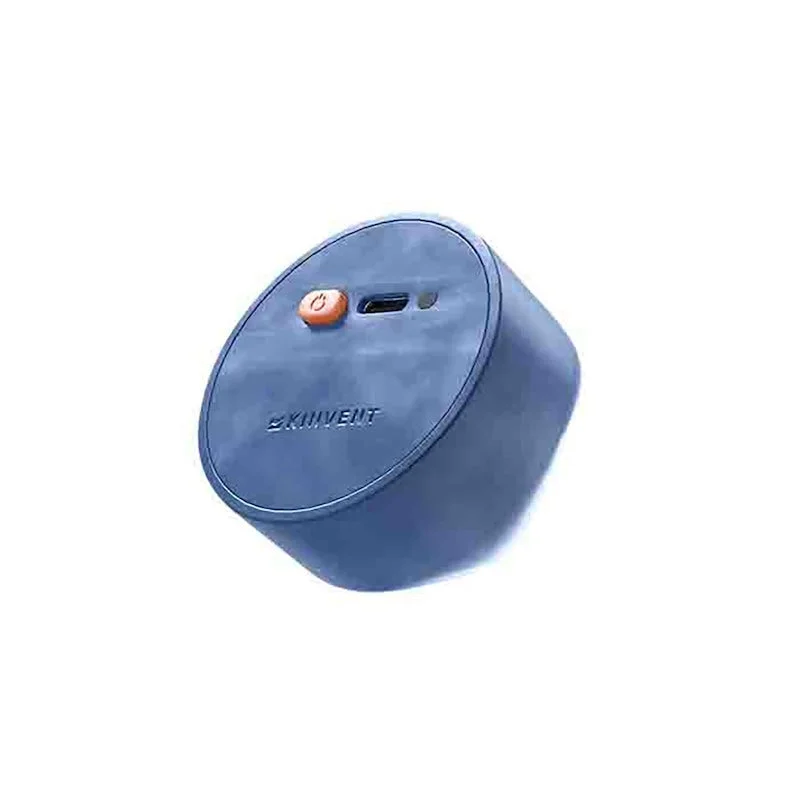
Pneumatic Sensor
Kinvent K-Bubble
K-Bubble works on air. Plug the sensor into an inflatable ball or cushion, have the body part press into it, and the change in internal air pressure becomes a force figure in the K-Force app. Pressure arrives as a continuous trace, so the effort is visible from the first moment of contact.
That pneumatic route suits positions where a rigid pad has nowhere to sit. A ball between the knees captures adductor effort. A cushion behind the head captures work at the cervical spine. Inflating the accessory harder or softer sets how much resistance the body meets before the reading starts to climb.
ReadsAir pressureConverted into forcePlugs intoBall or cushionAny inflatable accessoryWeight4.41 lbsSensor and accessoriesDimensions13.78 x 10.24 x 13.78Inches, as publishedPressure read as forceAdductors and cervical spineResistance set by inflationWireless to the K-Force app
The Mechanism
Air Carries The Measurement
The sensing element sits in the air line, which is why the contact surface can be soft, curved and any size the accessory allows.
?Pressure translated to forceSqueezing or pressing an inflated accessory raises the air pressure inside it. K-Bubble converts that variation into a force value and streams it while the effort is under way.Pneumatic sensing⚽Ball or cushionThe sensor plugs into an inflatable touch ball for adductor work, or into an inflatable cushion for the cervical spine. Swapping the accessory changes the shape of the test.Interchangeable?Inflation sets the loadHow hard the accessory is pumped decides the pressure level the body works against. The same sensor covers a soft starting level and a firm one without any change of hardware.Adjustable levels?Live visual feedbackThe app displays the reading as it changes, which gives the person being tested something to hold steady against and the tester a curve to judge the effort by.Biofeedback display
Where It Earns Its Place
Positions That Need A Soft Contact
For clinics and performance departments that need a force figure from positions where a rigid pad has nowhere to sit.
?Adductor effort through a squeezed ballBall test?Cervical spine work against a cushionCushion test?Maximum force from the pressure peakPeak⏱Mean force across a sustained holdAverage⇆Same test run on each side in turnSymmetry?A target on screen to press towardFeedback?Accessory set supplied with the sensorIncluded?Records land in the same app as the restK-Force
Closer Look
Two Accessories, Two Kinds Of Test
Touch Ball
Squeeze Tests And The Adductors
Connected to an inflatable touch ball, K-Bubble reads what happens when the ball is compressed between two limbs or between a limb and a surface. Adductor testing is the classic use, and the ball adapts to the space available between the limbs, so the contact angle follows the position you need.
- Plugs into any inflatable touch ball
- Reads compression as a force value
- Peak and mean force from one effort
- Inflation level sets the working resistance
- Isometric holds and moving efforts both supported
AdductorsPeak forcePneumaticCushion
Pressing Into A Soft Surface
Swap to an inflatable cushion and the same sensor covers pressing efforts at the cervical spine and anywhere else a curved, padded contact makes the position workable. The trace on screen updates continuously, so a slow build and a sharp spike look different from each other.
- Any inflatable cushion becomes the contact surface
- Continuous trace during the whole effort
- Visual target for holding a steady level
- Results stored against a profile in the app
- Published size 13.78 x 10.24 x 13.78 in, 4.41 lbs
Cervical spineLive traceK-Force app
The Range
Choosing Between The Four Sensors
One app runs all four. Each takes force in by a different route, and the route decides which tests it suits.
K-PushHandheld dynamometer for isometric muscle strength.Isometric strengthHandheldK-Force appShop the K-PushK-GripGrip dynamometer for grip strength and fatigue.Grip strengthPeak forceK-Force appShop the K-GripYou’re HereK-BubblePneumatic sensor for pressure and muscle activation.PressureActivationK-Force appCurrently viewingK-PullTraction dynamometer for tensile force.Tensile forceTractionK-Force appShop the K-Pull
Questions
Frequently Asked Questions
Pressing on a sealed, inflated accessory raises the air pressure inside it. K-Bubble measures that pressure variation and converts it into a force value shown in the K-Force app.Kinvent describe it as working with any inflatable touch ball or cushion. The ball suits squeeze tests such as the adductors; the cushion suits pressing efforts, including at the cervical spine.Maximum force from the peak of the effort, and mean force across a hold of the duration you choose. Running the same setup on each side in turn gives you the two figures to compare.Yes, by how far the accessory is inflated. A softer accessory gives way sooner and a firmer one holds its shape, which is how the same sensor spans different pressure levels without different hardware.Not in the material we hold. The published specification covers 13.78 x 10.24 x 13.78 in and 4.41 lbs, so those are the numbers on this page. We do not quote a range we cannot source.The reading updates continuously on screen. That live display doubles as a biofeedback target, giving the person a level to reach and hold while the effort is still under way.Kinvent list isometric, isotonic and biofeedback-based work for this sensor. Because the air path responds throughout the contact, a moving effort produces a trace in the same way a held one does.Kinvent state that all K-Bubble accessories are included. Their listing does not break the set out item by item, so we repeat it as published without adding a count.Rehabilitation clinics, physiotherapists in private practice, sports medicine departments and research teams. K-Bubble supplies the measurement; the choice of test and the reading of the result stay with the professional.K-Push takes force through a rigid pad held against a limb and publishes a 90 kg range at 0.1 kg. K-Bubble takes it through air in a soft accessory, which opens up positions where a hard pad cannot be placed comfortably, such as a ball held between the knees.