Jugs | BP3 Softball
Jugs BP3 Softball Pitching Machine
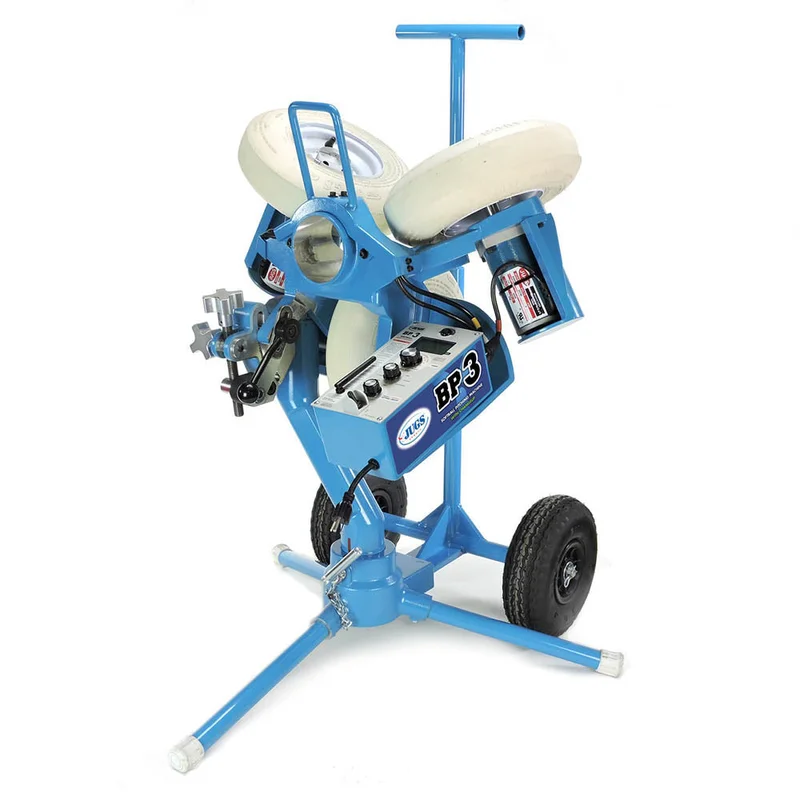
Every other machine in this group throws pitches. The BP3 Softball throws at-bats. Jugs publishes automatic pitching circuits on this model, programmed fastball and changeup sequences that run without anyone touching the machine, so a hitter steps in and gets a sequence, not a stack of identical reps. Add the remote-control changeup, which Jugs says switches between fastballs and changeups without giving the hitter a visual cue, and a coach can either let the circuit run the at-bat or take it over from behind the plate on the pitch he chooses. That is the whole reason the BP3 Softball exists alongside the SP3 Softball, which throws at exactly the same 45-75 mph.
Eight pitches sit on the Select-A-Pitch dial. Jugs names risers, drop balls, curveballs and screwballs among them and does not enumerate all eight. Pinpoint patented horizontal and vertical micro-adjustments handle zone control. A large 3 in. LCD display carries the speed, the biggest published display in the softball line. Underneath, three 1/4 HP motors turn three Grip-Tite 12 in. pneumatic tires that Jugs gives a 20-year lifespan. The machine comes standard with the Long Feed Chute and its Always-See-The-Ball delivery system, and a transport cart and keychain remote are referenced as standard. Jugs publishes no power source, weight, feed rate or dimensions for the BP3 Softball, and this page does not supply them from elsewhere.
Speed Range45-75 mphSame as the SP3 SoftballPitchesEightSelect-A-Pitch dialLCD Display3 in.Largest in the softball lineGrip-Tite Tires12 in.20-year lifespanProgrammed fastball and changeup sequencesRemote changeups from behind the plateLong Feed Chute standardPinpoint zone control
Inside the BP3 Softball
Four Things That Separate It From the SP3 Softball
Both machines throw 45-75 mph and both use Pinpoint micro-adjustment. Everything below is published on the BP3 Softball page and not on the SP3’s.
?Automatic Pitching CircuitsA pitcher does not throw the same pitch nine times. She sets a hitter up, and the sequence is the thing a hitter has to learn to survive. Jugs publishes automatic pitching circuits on the BP3 Softball: programmed fastball and changeup sequences that simulate real at-bats. The machine runs the sequence itself, so the pattern of speeds arrives without a coach standing at a button, and a hitter who tries to guess the next pitch off the coach’s body language has nothing to read. That changes what a round is for. No swing gets grooved: the hitter has to hold her weight back on a changeup she did not call, then get the barrel going again on the fastball behind it. Jugs also states the machine switches between fastballs and changeups without giving the hitter a visual cue. This is the only machine in the Jugs softball line that publishes programmed sequences at all; the Changeup Super Softball switches speeds only when someone presses the button.Sequences, not pitches?Changeups on a KeychainWhen the coach wants the call, Jugs states speeds change from behind the plate or at the machine with the touch of a button, with a keychain remote referenced as standard. Behind the plate is the useful half of that. A coach who can see the front shoulder and the hands picks the pitch where the hitter has already committed, which is the only place a changeup teaches anything. On the BP3 the changeup is one behaviour inside an eight-pitch dial, so a curveball round and a changeup round come off the same machine without a setup change.Keychain remote?The Long Feed ChuteJugs states the BP3 Softball comes standard with the Long Feed Chute and calls the mechanism Always-See-The-Ball: the delivery system lets hitters track pitches from release to contact. Tracking is the whole difficulty of machine work. A hitter who cannot see the ball until it is already out has no timing information, so she guesses, and a guessing hitter learns a guessing swing. A longer chute gives her the ball earlier in its path, closer to how a windmill delivery hands the ball over. Jugs publishes no inch measurement for the chute on this machine.Always-See-The-Ball⚙Three Motors, a 3 in. ScreenThree 1/4 HP motors turn three Grip-Tite 12 in. pneumatic tires, which Jugs gives a 20-year lifespan. Those are the middle-sized Grip-Tite wheels in the softball line, between the mini3’s 9 in. and the Changeup Super’s 16 in. Above them sits a large 3 in. LCD display, the only display Jugs measures anywhere in this set of five. On a machine that runs changeup circuits, a screen that can be read from the back of the cage is what tells a coach which speed the circuit is currently on.Three 1/4 HP motors
The published figures
Eight Lines From the BP3 Softball Spec Sheet
Every line below appears on the manufacturer’s BP3 Softball page. RFA’s older three-circuit count and longer ball list are not among them.
?45-75 mph speed rangeSet by knob?Eight pitches on one dialSelect-A-Pitch?Automatic pitching circuitsFastball and changeup sequences?Remote-control changeupsFrom behind the plate?Pinpoint pitch targetingPatented, two axes?Large 3 in. LCD displayReadable from the cage⚫Grip-Tite 12 in. tires20-year lifespan?Long Feed Chute standardAlways-See-The-Ball
Closer look
Three Ways a Program Uses This Machine
At-bat simulation
Let the Circuit Run the At-Bat
Set the circuit and step back. Jugs states the programmed fastball and changeup sequences simulate real at-bats, which is a different job from throwing a good pitch. A hitter who takes forty identical fastballs finishes practice with a timing pattern that no pitcher will ever reproduce. A hitter who takes a sequence has to reset between pitches, and resetting between pitches is the skill. The 3 in. LCD keeps the current speed visible from where the coach is standing, and Jugs describes the fastball-to-changeup transition as happening without giving the hitter a visual cue. Jugs does not publish how many circuits the machine holds, so ask if the count matters to your plan.
- Automatic pitching circuits with programmed fastball and changeup sequences
- Switches between fastballs and changeups without a visual cue
- Remote-control changeups from behind the plate or at the machine
- Keychain remote referenced as standard
- Large 3 in. LCD display shows the set speed
Auto circuitsRemote changeups3 in. LCDPitch selection
Eight Pitches, and the Four Jugs Names
The Select-A-Pitch dial holds eight pitches on the BP3 Softball and Jugs names four of them: risers, drop balls, curveballs and screwballs, plus the fastball and changeup the machine is built around. The manufacturer does not print the full list of eight, and this page does not guess at the remainder. RFA’s olderenumerated all eight, adding right and left-handed variants of the curveball and screwball, which is the likely reading, though it is not corroborated by the current manufacturer page. Alongside the dial, Pinpoint patented horizontal and vertical micro-adjustments handle zone control, the same system Jugs publishes on the SP3 Softball.
- Eight pitches on the Select-A-Pitch dial
- Risers and drop balls
- Curveballs and screwballs
- Fastballs and changeups
- Pinpoint patented horizontal and vertical micro-adjustments
8 pitchesPinpoint45-75 mphDefense and feed
Fly Balls, Blocking Drills and Two Named Softballs
Jugs lists the BP3 Softball for fly ball drills, defensive drills and blocking drills, so the machine that ran the hitting period turns and runs the catcher’s period. Blocking work is the one worth the setup time: a catcher needs balls in the dirt at a repeatable speed and a repeatable angle, and Pinpoint’s vertical adjustment is what puts them there pitch after pitch. On the feed side the machine comes standard with the Long Feed Chute. The ball list Jugs publishes here is short, two entries: LeatherLast softballs and low impact, multi-use practice softballs. RFA previously advertised a longer list including Sting-Free, Lite-Flite, SOFTIE and BULLDOG softballs, and those are not corroborated by the current manufacturer page for this machine.
- Fly ball drills, defensive drills and blocking drills
- Comes standard with the Long Feed Chute
- Always-See-The-Ball delivery system tracks release to contact
- LeatherLast softballs
- Low impact, multi-use practice softballs
- Transport cart referenced as standard
Blocking drillsLong Feed ChuteTwo ball types
Compare
Five Jugs Softball Pitching Machines
One wheel or three, 15 mph to 75 mph, with and without a remote changeup. The BP3 Softball is the top of the line: the only one that runs programmed at-bat sequences on its own.
Jugs BP1 SoftballShips with the 12 in. softball chute and throws risers, fastballs and drops from 15-70 mph; the 11 in. chute is sold separately.15-70 mph12 in. chute16 in. tire2-year warrantyShop the Jugs BP1 SoftballJugs Changeup Super SoftballA handheld remote switches from 70 mph fastballs to 44 mph changeups, and the 16 in. Grip-Tite tire lasts 4x longer than solid tires.70 mph fastballs44 mph changeupsHandheld remoteASA and USA SoftballShop the Jugs Changeup Super SoftballJugs mini3 SoftballThree 1/4 HP motors and 9 in. Grip-Tite tires drive 7 pre-set pitches from 30-70 mph, with a transport cart listed on the machine.30-70 mph7 pre-set pitches9 in. tiresTransport cartShop the Jugs mini3 SoftballJugs SP3 SoftballSeven pitch types from 45-75 mph, including right and left-handed curves and screwballs, with Pinpoint micro-adjustment for horizontal and vertical placement.45-75 mph7 pitch typesPinpoint micro-adjust2-year warrantyShop the Jugs SP3 SoftballYou’re HereJugs BP3 SoftballEight pitches from 45-75 mph with remote-control changeups, a 3 in. LCD display and programmed fastball and changeup sequences that simulate real at-bats.45-75 mph8 pitches3 in. LCD displayRemote changeupsCurrently viewing
Questions
Frequently Asked Questions
Four things Jugs publishes on the BP3 and not the SP3: remote-control changeups, automatic pitching circuits running programmed fastball and changeup sequences, a large 3 in. LCD display, and an eighth pitch on the dial. Both machines run 45-75 mph and both use Pinpoint micro-adjustment. If nobody in your program needs a mid-round speed change, the SP3 does the pitch and location work.Jugs describes them as programmed fastball and changeup sequences that simulate real at-bats. The machine runs the sequence on its own, so the hitter faces a pattern of speeds, never a single repeated pitch. Jugs does not publish how many circuits the machine stores. RFA’s older page said three preset hitting circuits; that count is not on the current manufacturer page and is not claimed here.Jugs states you change speeds from behind the plate or at the machine with the touch of a button, with a keychain remote referenced as standard, and that the machine switches between fastballs and changeups without giving the hitter a visual cue. Either the coach calls it or the automatic circuit does.Jugs states eight and names risers, drop balls, curveballs and screwballs, alongside the fastball and changeup the machine is built around. The manufacturer does not print all eight by name. The SP3 Softball does enumerate its full list of seven, so if you need to know exactly what a dial position throws, that page is more specific.A longer ball chute that comes standard on the BP3 Softball. Jugs calls the mechanism Always-See-The-Ball and states the delivery system lets hitters track pitches from release to contact. No inch measurement is published. It is the only chute Jugs names on a three-wheel softball machine.The current manufacturer page names two: LeatherLast softballs and low impact, multi-use practice softballs. RFA’s earlier page also listed Sting-Free dimpled and seamed, Lite-Flite, SOFTIE and BULLDOG softballs. Those are not corroborated by Jugs for this machine, so confirm with Jugs before buying them for the BP3.Jugs publishes no power source in the BP3 Softball’s specification copy. The manufacturer page does cross-sell a Bluetti AC70 Portable Power Station as a recommended product, which is a recommendation and not a stated compatibility. The BP1 Softball and mini3 Softball name the BLUETTI AC70P explicitly; the BP3 page does not. Confirm the electrical requirement with Jugs.Grip-Tite 12 in. pneumatic tires, three of them, with a 20-year lifespan stated by Jugs. Grip-Tite is Jugs’ patented tire construction and runs in three sizes across the softball line: 9 in. on the mini3, 12 in. here, and 16 in. on the Changeup Super, where Jugs states it lasts 4x longer than a solid tire.Yes. Jugs lists fly ball drills, defensive drills and blocking drills for the BP3 Softball. Blocking work is where the Pinpoint vertical adjustment matters, because a catcher needs the ball in the dirt in the same place repeatedly.A transport cart is referenced as standard on this machine. Jugs publishes no weight for the BP3 Softball, and no weight for any machine in this softball set, so ask for a shipping weight if one person will be handling it.The BP3 Softball is the only machine in this set of five with a measured display: Jugs publishes a large 3 in. LCD. The BP1 Softball and Changeup Super Softball both have a digital speed readout with no size given, and Jugs publishes no display at all for the SP3 Softball or the mini3 Softball.Jugs states the machine comes standard with the Long Feed Chute, and references a transport cart and a keychain remote control as standard. There is no full itemised box-contents list on the manufacturer page, so treat softballs, feeders and protective screens as separate purchases and confirm the cart and remote on the order.